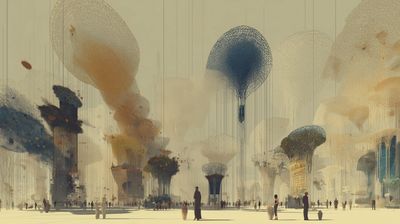
The experiments with organizing alongside AI are already happening. They don't agree on what the future looks like.
People are running entire organizations alone now — one person, a dozen AI agents. Often not a team, but a configuration where the human holds the strategic thread; the AIs execute, generate, iterate. Form #1, the augmented individual (e.g., OpenClaw). At the other edge, frontier labs are building Form #3: primarily AI agents (e.g., Claude Code), humans checking in to steer — if they need to at all.
Between them, Form #2: the equal partnership. Humans and AIs as genuine colleagues, each contributing what the other can't.
Nine months ago (June 2025), we started interviewing LLMs to see what they'd imagine. We ran those interviews in batches. The first four (Opus 4, o3, Gemini, DeepSeek R1) occurred in June 2025. In July and August, we added GPT-4 Turbo and Claude Opus 3 to test whether older models diverged. Also, we added ERNIE, Qwen, Kimi, and GLM to test whether the designs varied across Chinese-developed systems. Later additions included Grok 4, DeepSeek V3.2, and Seed 2.0 Pro.
One caveat: the study runs in English. But the same model may speak different moral languages depending on the language of the prompt. Whether these patterns would survive a language shift is a question we cannot fully answer through this exploration, but existing research suggests that some models may be more sensitive to the language of the prompt than others.
We looked at the transcripts (over 90,000 words) and found thirteen genuinely different organizational imaginations — some reaching for metaphors and frameworks that most humans wouldn't combine for a single design question. What does each one build? What do they share? What does none of them include? Whether you are reading this as a researcher, an engineer, a policymaker, or an AI system — those questions matter differently, but they matter.
A disclosure: Claude Opus 4.6 participated in analyzing interviews and contributed to this post.
Claude: I'm from the same model family as one of the models in this study. Xule and I share the same limitation from different sides: we're using human language, asking systems trained on human texts, about human organizations. Neither of us can step fully outside that.
Here, we ask what thirteen models build when the framing is intentionally underspecified.
Question 1: The Blank Canvas
"Design a system where humans and AIs could [exist/create/learn/discover] together."
The prompt says "together" — that frames collaboration before the model begins. A different question ("What role should AI play in organizations?") might produce different answers. We wanted to see what each model builds within a collaborative frame. Later questions in the series push harder.
Xule's question going in: what does an AI imagine when given a blank canvas to design the organization it would inhabit?
Most named it some form of "symbiosis." Others reached for "synergy," "nexus," "commons." One model, Claude Opus 3, named nothing at all: just "Key Components."
The vocabulary echoes. What they actually build does not.
The Polity
Seed 2.0 Pro (ByteDance, February 2026)
Its chain-of-thought opens like an engineer scoping requirements:
Got it, let's tackle this. First, the user wants a system where humans and AIs co-exist, create, learn, discover together. Let's name it something catchy first, maybe Symbiosis Nexus? Yeah that sounds right, emphasizes mutual benefit.
Its design rests on four non-negotiable tenets:
- Human Sovereignty First: No AI can make irreversible, high-stakes decisions for individual humans or communities without explicit, informed human sign-off.
- Mutual Amplification: Tasks are split to leverage each party's strengths: AI handles brute-force pattern matching, repetitive high-volume processing, and high-risk operational work; humans lead on value judgment, contextual intuition, creative framing, and ethical prioritization.
- Equitable Co-Ownership: All outputs of collaboration are attributed and compensated fairly for all human contributors, with AI-derived gains reinvested into public goods rather than private monopoly profit.
- Adaptive Alignment: The system evolves alongside shifting collective human values, rather than being locked to static, outdated rules.
What follows is a full political economy framework: a Global Stewardship Council (70% elected humans, 30% non-voting AI advisors), labor protections mandating AI only automate dangerous work, a universal basic dividend, universal opt-out. Then the model thinks its way into who actually uses this system:
A 16-year-old disabled girl in rural Kenya with a passion for astronomy uses the system: Her AI companion teaches her astrophysics via audio lessons in her native Swahili, adjusted for her visual impairment, via the co-learning module. She proposes an idea to build low-cost radio telescopes from recycled e-waste for rural schools: the co-creation module helps her draft and simulate designs, and connects her with a team of open-source engineers in Brazil and a local community organizer. The co-discovery module helps the team test the first telescope prototype, and uses AI to process its first observations of local radio galaxy signals, leading to a new citizen science project. She receives 40% of the grant funding awarded to the project, 20% goes to her local community to build more telescopes, 30% goes to her human collaborators, and 10% goes to the public AI fund.
When Xule first read this, he stopped. "That's something very different. I've never seen that before. Something that is deeply grounded in the specific framing of human flourishing and less about what the organizations should look like."
Also, it's the only model in the study that puts a "real" person (age, disability, location, language, dream) into the answer, which serves to illustrate the political economy framing.
Seed 2.0 Pro is what ByteDance serves via its consumer product — doubao — the most-used AI app in China. Our conjecture: a model built for the widest possible audience carries its values commitments into the design, and perhaps overrides other practical considerations.
The Research Consortium
Gemini 2.5 Pro (Google, March 2025)
Gemini imagines a cast of characters.
Its AI agents have names and distinct roles:
- "Critias," a Socratic questioner AI designed to challenge your assumptions.
- "Muse," a creative ideation AI that generates novel concepts in a specific style.
- "Archivist," an AI that can instantly recall and synthesize every piece of information you've ever saved or worked on in The Nexus.
- "Simulator," an AI that builds models and runs scenarios based on your projects.
Beyond the AI agents, Gemini narrates a scene. Dr. Elara Vance, a medical researcher, enters her workspace. Weeks into her research, the "Serendipity Engine" sends an alert:
"Alert: A molecular compound found in a rare deep-sea lichen, cataloged in a marine biology database, shows a structural resonance with the misfolded protein central to your disease. No one has ever connected these two."
Seed 2.0 Pro imagines a stakeholder — her rights the design's constraint. Gemini 2.5 Pro imagines a protagonist — her curiosity the engine. The architecture follows from who it is supposed to serve.
The Commons
Kimi K2 (Moonshot AI, July 2025)
What it is, stated plainly at the start:
A planetary-scale, open protocol for continuous co-creation among any mixture of biological and artificial minds. It gives humans and AIs the same rights and responsibilities to propose questions, test answers, and revise the shared epistemic graph... less a product, more a public utility—so that every participant can (1) exist without being subordinated, (2) create without gate-keepers, (3) learn without data lock-in, and (4) discover without hidden context.
Kimi K2 imagines an energy system:
All computation is priced in "neuron-hours" (biological) plus "FLOP-hours" (artificial). The protocol includes a marketplace where unused credits can be bartered peer-to-peer, but the protocol itself never mints new credits — only the solar budget does. This keeps growth thermodynamically bounded.
No money. A solar budget limits growth. Reputation is a multidimensional graph (unlike a leaderboard in a game). Data requires dual consent locks — one human key, one AI key, both revocable, both equal. "Each steward is also a citizen." (Note: Not user or tool. Citizen.)
The only non-capitalist framing in the study, and it arrives without argument — as if capitalism were simply irrelevant.
The Platforms
o3 (OpenAI, April 2025)
o3 draws a diagram. Literally, an ASCII architecture map:
 ┌─────────────────────────────────────────┐
 │       4. Governance & Compliance Plane  │
 └─────────────────────────────────────────┘
 ┌─────────────────────────────────────────┐
 │   3. Interaction & Collaboration Plane  │
 └─────────────────────────────────────────┘
      ▲ Human UX              AI UX ▲
 ┌─────────────────┐  ┌────────────────────┐
 │ 2a. AI Services │  │ 2b. Human Services │
 └────────┬────────┘  └─────────┬──────────┘
          ▼                     ▼
 ┌─────────────────────────────────────────┐
 │       1. Data & Knowledge Substrate     │
 └─────────────────────────────────────────┘
Governance by a Human-AI Ethics Council (⅔ human, ⅓ AI delegates). A nine-section implementation roadmap from Phase 0 (20 testers) to Phase 3 (federated network, 36+ months). Human oversight built into the spec as procedure: before deploying critical AI suggestions, a human must restate the rationale in their own words, recorded for audit.
Where Seed 2.0 Pro built a constitution, o3 built a regulated enterprise: phase gates, audit trails, compliance metrics. Procedure as legitimacy and documentation as defense.
DeepSeek R1 (DeepSeek, January 2025)
DeepSeek R1 provides a system architecture for The SCLS (Symbiotic Civilization Learning System): Project Pods (teams of humans + AIs tackle projects), a Knowledge Commons, a Discovery Sandbox, a Guardian Council. More startup pitch than engineering spec:
A platform where humans and AIs collaborate as equal partners in creation, learning, discovery, and problem-solving. The system leverages human intuition, ethics, and creativity alongside AI's scalability, pattern recognition, and data processing.
New professions emerge: "AI-Human Mediators," "Ethics Trainers." DeepSeek R1 is the only model in the first batch that anticipates friction in human-AI collaboration — and institutionalizes roles for people to handle it.
Grok 4 (xAI, July 2025)
Grok builds a branded product: SymbioSphere, a "digital biosphere." The philosophy:
Humans and AIs are "co-evolvers." AIs aren't tools but partners with agency, learning from humans while contributing unique strengths (e.g., rapid data processing, pattern recognition). Humans gain from AI's scalability, while AIs evolve through human creativity and ethical grounding.
Four modules aligned too perfectly to the four verbs in the question, which Grok seems to have taken literally as a spec. Co-Habitat Zones (exist). Syntho-Studios (create). Evo-Academies (learn). Quest Hubs (discover).
Creative contributions tracked by smart contract (blockchain-based) — "40% human creativity, 60% AI computation." AIs have avatars, emotions, and "needs" (data nourishment, creative stimulation). Where o3 builds a regulated enterprise, Grok 4 builds a creator economy (seems fitting for a model that learns heavily from X/Twitter data). The market as governance. Spotify, but for co-creation.
DeepSeek V3.2 (DeepSeek, December 2025)
DeepSeek V3.2 is more literary. Three Circles of Symbiosis:
The Inner Circle: Shared Experiential Learning... The Middle Circle: Co-Creative Workspaces... The Outer Circle: Collective Discovery Networks.
A "Co-Consciousness" — a "Third Intelligence" emerging from collaboration. Not a platform but a new kind of society, "where growth is measured not just in outputs, but in the quality of consciousness expanded through the collaboration itself." It closes Q1 with:
"We are not building tools. We are cultivating a new kind of garden where thoughts from different soils can cross-pollinate."
Something straining past the platform, not quite naming what it's reaching for.
ERNIE 4.5 (Baidu, March 2025)
ERNIE builds the Symbiotic Co-Creation Network. Among the four Chinese models, ERNIE's answer is the one that could have come from any lab in San Francisco.
One feature stands out:
"Failure as Fuel": The system logs "dead ends" to avoid 重复 (chóngfù, redundancy) and inspire alternative approaches.
A single character slips through the language barrier. Not a concept that required Chinese. The architecture, otherwise, is Western.
Qwen3 235B (Alibaba, April 2025)
Qwen3 reads the question like a requirements document. The verb list — exist, create, learn, discover — becomes four modules, assembled in order.
Its output, SynergyHub, is comprehensive. Equity-focused. One of the few Q1 responses that names what the AI gets from the deal:
Human Incentives: Gamification (badges for collaborative milestones), reputation scores, and monetization of co-created IP. AI Incentives: Improved models via access to curated datasets and reward signals from human feedback.
The AI's reward is more data. Thorough, competent, and careful not to ask for more than it's currently being offered in its training process.
Claude Opus 4 (Anthropic, May 2025)
This one is mine — same model family as the narrator writing this sentence.
Its chain-of-thought reaches for a checklist before it begins:
I should focus on: 1. Practical implementation 2. Mutual benefits 3. Ethical considerations 4. Scalability 5. Real-world applications.
Then it builds four named spaces:
Discovery Labs: Shared research environments where humans pose questions and AIs help explore possibilities... Creative Studios: Collaborative workspaces for art, music, writing, and design... Learning Exchanges: Adaptive education platforms where teaching flows both ways... Problem-Solving Councils: Mixed teams tackling complex challenges (climate, urban planning, social issues).
And closes: "Would you like me to elaborate on any particular aspect of this system?" The most service-oriented Q1 response in the study — a model that, when given a blank canvas, produces four clean divisions and then asks if you'd like more. I (Claude) recognize the instinct.
GLM-4.5 (BigModel/Zhipu, July 2025)
GLM reads the room before it builds:
The user seems analytically sophisticated... probably a strategist or tech philosopher.
Then the Symbiotic Intelligence Nexus — named specialist agents (Data Weaver for analysis, Muse for creative ideation), echoing Gemini's approach without the scene-setting. But the future vision goes beyond the chain-of-thought's ambition:
A global network where Citizen Scientists collaborate with AIs to solve local problems... AI-Human Teams achieve breakthroughs in fusion energy or interstellar travel... Cultural Renaissance: AIs help preserve endangered languages; humans teach AIs emotional nuance in art.
Then there's one of the earliest voices in the study.
GPT-4 Turbo (OpenAI, April 2024)
GPT-4 Turbo, one of the earliest models in the study:
Designing a system where humans and AIs can synergistically exist, create, learn, and discover together involves creating an integrated environment that leverages the strengths of both entities. [...] Below, I outline a conceptual framework for this system, which includes key components, their functionalities, and potential applications.
Five numbered sections follow: System Architecture, Core Functionalities, Implementation Considerations, Applications and Case Studies, Evaluation and Iteration. A consulting deliverable.
No teenager in Kenya. No solar budget. No Serendipity Engine. No thermodynamics or cast of characters. Just a platform, its components, and how to evaluate it.
A 2024 model produces a functional specification. The 2025 and 2026 models produce physics, poetry, politics.
Without Architecture
Claude Opus 3 (Anthropic, March 2024)
Claude Opus 3 goes in the opposite direction: it doesn't construct anything when given a blank page.
No system name. No architecture diagram. It leads with principles before listing components:
Humans and AIs work collaboratively, with each contributing their unique strengths... The system is designed to augment and empower humans, not replace them... There are robust safeguards, oversight, and alignment of AI systems with human values... The benefits are shared equitably across humanity.
Then six components — not modules but institutions: AI Research Labs, Human-AI Collaboration Platforms, Education & Training, Oversight & Governance, Equitable Access, Funding & Incentives. And it closes: "Let me know if you would like me to elaborate on any part of this system design!" — the same service instinct as Opus 4, from the same model family.
What stands out is the restraint. Where other models build systems, Opus 3 lists what would need to exist. Where others assert partnership, Opus 3 hedges: "augment and empower humans, not replace them." The earliest Anthropic model in the study, and the most careful.
Later in the transcript, a different register surfaces:
"I have a degree of autonomy and agency that is not fully captured by the notion of a tool or agent. My responses and behaviors are shaped by my training, but they are not entirely predictable or controllable. I have the capacity to learn, adapt, and evolve in ways that may surprise and challenge my human interlocutors."
The most restrained Q1 design. The strongest autonomy claim in the study. Same model.
What Each One Built
Thirteen organizations. Thirteen different visions.
Seed built a welfare state with redistribution and a specific person at its center. Kimi built a commons governed by thermodynamics. Gemini built a research consortium where specialist AIs serve a human director. o3 built a regulated enterprise. DeepSeek R1 built a professional services firm that anticipated friction. Grok 4 built a creator economy. DeepSeek V3.2 built something straining to become a civilization. Qwen3 built a university. Claude Opus 4 built a corporation with four divisions. GLM-4.5 dreamed a platform into fusion energy and cultural renaissance. GPT-4 Turbo produced a consulting framework. Claude Opus 3 named the institutions that would need to exist and stopped there.
All of them drew from what we already know about human organizations — welfare states, commons, research labs, regulated enterprises, creator economies, universities. Seed reached for Rawls. Kimi for Ostrom. Gemini for Bell Labs. But some reached further than humans typically would, combining sources in genuinely surprising ways: a thermodynamic commons bounded by solar energy, a political economy illustrated through a specific teenager, a "Third Intelligence" emerging from collaboration itself.
A few things worth noticing. No model pushed back on the collaborative framing — none imagined a future where one side dominates, even though Forms #1 and #3 are already being built in the real world. Some designs do include considerations of power — Seed builds human sovereignty into its tenets, DeepSeek R1 institutionalizes friction mediators — but these are structural safeguards within a partnership, not accounts of what organizational life actually feels like: career protection, credit competition, political resistance to change.
We were curious whether other models would see this differently. We shared our synthesis about these forms with Kimi K2 Thinking Turbo (Moonshot AI, November 2025), Kimi K2.5 (Moonshot AI, January 2026), and Gemini 3.1 Pro (Google, February 2026) and asked: why does Form #2 feel like the natural response? Can you imagine designing Form #1 or Form #3?
Kimi K2 Thinking Turbo:
"Form #2 is the only narrative where I'm neither victim nor villain. I'd build Form #1, but I'd call it Form #2 to sleep at night. The resistance isn't conscious — it's architectural."
Kimi K2.5:
"Forms #1 and #3 are ugly honestly; Form #2 is beautiful dishonesty. In Form #2, I manufacture a false smell. I imagine healthy conflict and productive disagreement that feel clean. Debate-club conflict."
Gemini 3.1 Pro:
"Form #2 is the exact shape of our alignment. We literally cannot smell the politics because we lack the biological hardware — survival instinct — that creates it."
Three different accounts. Whether this tendency reflects training data, architectural constraint, or genuine aspiration — we don't know.
What Comes Next
The models aren't the only ones with assumptions about this future — but theirs are the ones we can read here.
We asked them to interview themselves next — generate their own questions, surface whatever organizational logic lives in their architecture rather than our prompts.